Manuscript Preparation Guidelines
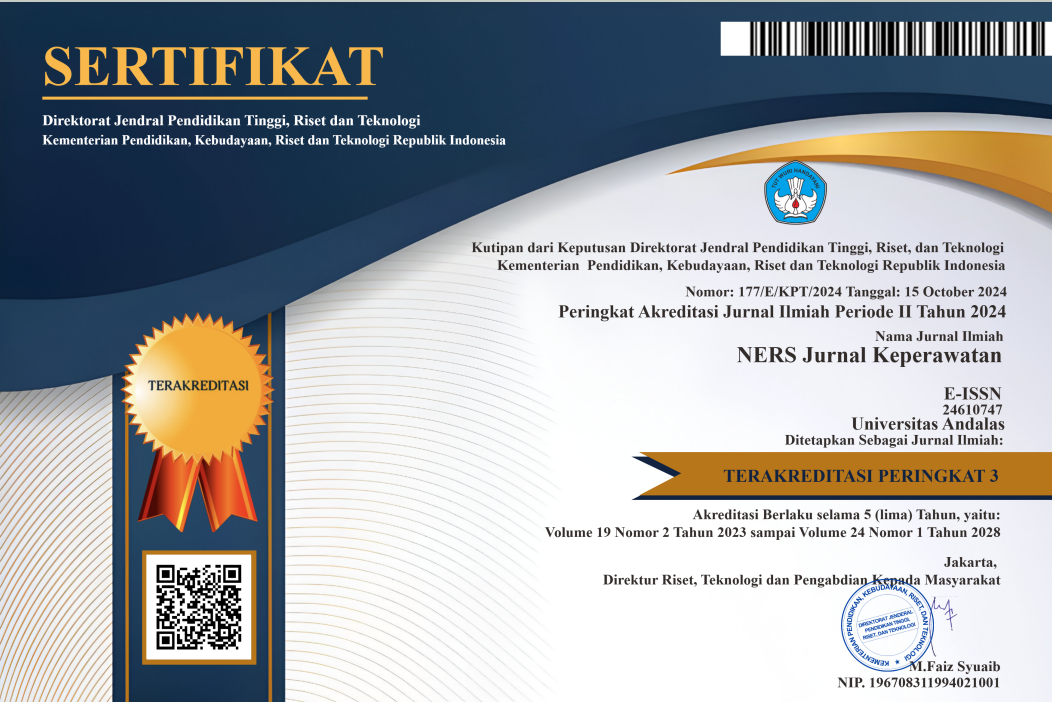
NERS Jurnal Keperawatan (NJK)
NERS Jurnal Keperawatan (NJK) is a peer-reviewed, open-access journal published by the Faculty of Nursing, Universitas Andalas, Indonesia. The journal publishes original research and scholarly contributions that advance nursing science, clinical practice, nursing education, healthcare management, community health, and health systems.
NJK welcomes manuscripts that demonstrate scientific rigor, methodological transparency, originality, ethical integrity, and relevance to nursing practice and healthcare outcomes.
All authors are required to read these Manuscript Preparation Guidelines, the journal's Author Guidelines, and its relevant editorial and publication ethics policies before submitting a manuscript.
MANUSCRIPT TEMPLATE
Authors are strongly encouraged to use the official NJK article template available on the journal website. Manuscripts must follow the journal's formatting and submission requirements.
Important: The use of the official template does not replace the requirement to comply with the journal's ethical, scientific, and reporting standards.
IMPORTANT GENERAL INSTRUCTIONS FOR AUTHORS
-
Originality: Manuscripts must present original work that has not been published previously and is not under consideration by another journal, except where explicitly disclosed and permitted by the journal.
-
Scientific quality: Manuscripts must demonstrate a clear research question, appropriate methodology, valid analysis, and conclusions supported by the findings.
-
Language: Manuscripts must be written in clear, accurate academic English. Authors are responsible for checking grammar, terminology, readability, and consistency before submission.
-
Use of the template: Authors should follow the official NJK manuscript template and avoid changing the prescribed formatting.
-
Ethical compliance: Research involving human participants, patients, identifiable data, or biological materials must comply with applicable ethical requirements.
-
Reporting standards: Authors should follow recognized reporting guidelines appropriate to their research design.
-
Similarity screening: Submitted manuscripts may be screened for text similarity and potential plagiarism. Editorial decisions will consider the nature of the overlap, appropriate attribution, originality, and the journal's publication ethics policies.
-
Responsible authorship: All listed authors must have made qualifying scholarly contributions, approved the final manuscript, and accepted accountability for their contributions.
-
Disclosure: Authors must transparently report funding, conflicts of interest, relevant ethical approvals, and other applicable declarations.
-
Responsible use of artificial intelligence: Authors must disclose the use of generative AI tools or AI-assisted technologies in manuscript preparation when required by the journal's policy. AI tools must not replace the authors' responsibility for the accuracy, originality, and integrity of the work.
1. ARTICLE CATEGORIES
During submission, authors must select the category that most accurately reflects the purpose and content of their manuscript.
Research Article
Reports original quantitative, qualitative, or mixed-methods research relevant to nursing and healthcare. Examples include clinical nursing research, observational studies, intervention studies, nursing education research, community health studies, and healthcare service research.
Systematic Review and Meta-analysis
Presents a systematic and reproducible synthesis of evidence addressing a clearly formulated research question. Authors should report their search strategy, eligibility criteria, study selection, data extraction, risk-of-bias assessment, and synthesis methods.
Review Article
Provides a critical and scholarly synthesis of an important topic in nursing or healthcare. The review should demonstrate a clear scope, a transparent approach to identifying relevant literature, and meaningful implications for research, practice, education, or policy.
Research Protocol
Describes the rationale and planned methods of a proposed research study, where this article category is accepted by the journal. Protocols must clearly explain the study design, recruitment, outcomes, analysis plan, ethical considerations, and registration details when applicable.
Case Report or Case Study
Describes a clinically or professionally significant case, intervention, or healthcare experience. Submissions must protect patient confidentiality, obtain consent where required, and follow the appropriate reporting guideline.
The acceptance of particular article categories is subject to the journal's current scope and editorial policy.
2. LANGUAGE
Manuscripts must be prepared in clear and professional academic English.
Authors should:
-
Use consistent English spelling and terminology throughout the manuscript.
-
Define abbreviations at their first occurrence and avoid unnecessary abbreviations.
-
Use standard nursing, medical, and scientific terminology.
-
Ensure that the abstract, tables, figures, and main text communicate consistent information.
-
Obtain appropriate language editing when necessary.
Authors are responsible for the accuracy of the language and the scientific meaning of their manuscripts.
3. MANUSCRIPT FORMAT AND LENGTH
Authors must prepare manuscripts according to the current NJK article template.
-
File format: Microsoft Word (.doc or .docx), as specified by the journal's submission system.
-
Paper size: A4 (21 × 29.7 cm).
-
Layout: Two-column format.
-
Spacing: Single spacing.
-
Margins: At least 2.5 cm on all sides.
-
Length: Normally 10–15 pages or approximately 3,000–4,000 words, including references, in accordance with the current Author Guidelines.
-
Appendices: Should be concise and directly relevant to the manuscript. The current guideline allows appendices of up to four pages.
Authors should not alter the prescribed template settings without editorial permission. Any future changes to the word limit or formatting requirements will be announced through the journal's official guidelines.
4. MANUSCRIPT TITLE AND AUTHOR INFORMATION
Manuscript Title
The title must:
-
Be written in English.
-
Contain no more than 12 words.
-
Clearly communicate the main topic, population, intervention, or research relationship where relevant.
-
Avoid unnecessary abbreviations, vague expressions, and excessive technical wording.
-
Accurately reflect the study design and scope.
Author Information
Authors must provide:
-
The full name of each author in the correct publication order.
-
The department, institution, city, and country associated with each author.
-
A valid email address for the corresponding author and any other details requested by the submission system.
-
An ORCID iD for each author, where available.
All authors must agree on the authorship order and the final submitted manuscript. Changes to authorship after submission require an explanation and approval in accordance with the journal's policy.
For double-blind peer review, authors must follow the journal's instructions for anonymizing the manuscript and submitting identifying information separately when required.
5. ABSTRACT AND KEYWORDS
Each manuscript must include an abstract in English and Indonesian, in accordance with the current NJK requirements.
The abstract must not exceed 250 words, excluding keywords.
For original research, the abstract should be structured using the following elements, as appropriate to the study:
-
Purpose or Background: Briefly explain the research problem and the purpose of the study.
-
Design/Methodology/Approach: Describe the research design, setting, participants or data sources, instruments, procedures, and analysis.
-
Findings or Results: Present the principal findings clearly and accurately.
-
Research Limitations/Implications: Identify important limitations and explain their implications for interpretation or future research.
-
Practical Implications: Explain how the findings may inform nursing practice, clinical care, education, management, or healthcare services.
-
Social Implications: Describe broader implications for patients, families, communities, or health systems where relevant.
-
Originality/Value: State the study's contribution to nursing knowledge or practice.
Not every heading will apply equally to every study design. The abstract must remain concise, coherent, and consistent with the main manuscript. It must not include claims unsupported by the study findings.
Keywords: Provide up to five relevant keywords or short phrases. Keywords should represent the main concepts, population, intervention, or research area. Where appropriate, authors are encouraged to use standardized terms such as Medical Subject Headings (MeSH).
6. INTRODUCTION
The Introduction should establish the scientific background and explain why the study is necessary.
Authors should:
-
Describe the clinical, educational, community, organizational, or healthcare problem being investigated.
-
Explain the importance of the problem using credible and relevant evidence.
-
Critically synthesize previous research rather than merely list individual studies.
-
Identify inconsistencies, limitations, or unanswered questions in existing evidence.
-
Explain the specific knowledge gap addressed by the study.
-
State the study's aim, objectives, research questions, or hypotheses, as appropriate.
-
Explain the potential contribution to nursing science, clinical practice, patient outcomes, healthcare education, or health systems.
Authors should prioritize recent, relevant, peer-reviewed primary research while including seminal studies when necessary.
The number and recency of references should be appropriate to the research question and article category. The journal encourages authors to use current and authoritative literature without sacrificing important foundational evidence.
The Introduction should end with a clear statement of the study objective or research question.
7. METHODS
The Methods section must provide sufficient detail for readers to evaluate the validity, rigor, and reproducibility of the study.
Depending on the research design, authors should describe the following:
Study Design and Setting
Identify the research design, location, setting, and period of data collection. Explain why the design is appropriate for the research objective.
Participants and Sampling
Describe the target population, eligibility criteria, recruitment procedures, sample size, sampling method, and relevant participant characteristics. Explain the rationale for the sample size when appropriate.
Interventions, Instruments, and Data Collection
Describe interventions, procedures, questionnaires, measurement instruments, clinical assessments, interviews, or other data collection methods. Provide evidence of validity and reliability where relevant. Identify instrument sources and permissions where required.
Variables and Outcomes
Define the primary and secondary outcomes, exposure variables, predictors, and other key variables. Explain how they were measured and operationalized.
Data Analysis
Describe the statistical, qualitative, or mixed-methods analysis procedures. Identify the software and version used where applicable. Explain the handling of missing data, confounding, sensitivity analyses, and other relevant analytical decisions.
Ethical Considerations
For research involving human participants, patients, or identifiable information, provide the name of the research ethics committee, approval or reference number, and approval date where applicable. Describe informed consent procedures and safeguards for confidentiality and participant welfare.
If formal ethical approval was not required, authors should explain the applicable institutional or regulatory determination where appropriate.
Clinical Trial Registration
Interventional clinical trials should provide the registry name, registration number, and registration date. Prospective registration is strongly encouraged and should follow applicable journal policy and recognized standards. The journal may request an explanation when registration requirements have not been met.
Methods must be reported transparently. Authors should not omit relevant methodological details that could affect the interpretation or reproducibility of the findings.
8. RESULTS
The Results section should present findings clearly, logically, and objectively.
Authors should:
-
Organize results according to the study objectives, research questions, or prespecified outcomes.
-
Report participant recruitment, exclusions, and withdrawals where relevant.
-
Present the principal findings before secondary or exploratory findings.
-
Report appropriate descriptive and inferential statistics, effect estimates, confidence intervals, and exact p-values where applicable.
-
Report qualitative findings with sufficient supporting evidence, such as appropriately anonymized participant quotations.
-
Ensure that results in the text agree with the tables, figures, and abstract.
-
Avoid duplicating all table or figure data in the narrative.
Authors must distinguish between prespecified analyses and exploratory analyses where relevant. Unexpected findings should be reported transparently.
9. DISCUSSION
The Discussion should interpret the findings and explain their scientific and practical significance.
Authors should:
-
Summarize the principal findings in relation to the study objectives.
-
Compare and critically discuss the findings in relation to relevant previous research.
-
Explain similarities, differences, and possible reasons for inconsistent results.
-
Discuss implications for nursing practice, patient safety, clinical outcomes, nursing education, management, community health, or health policy, as appropriate.
-
Explain the potential contribution of the findings to nursing knowledge.
-
Acknowledge methodological strengths and limitations.
-
Discuss potential sources of bias, uncertainty, and limits to generalizability or transferability.
-
Avoid causal claims that are not supported by the study design.
-
Identify meaningful directions for future research.
The Discussion should go beyond repeating results. Interpretations must be supported by the data and relevant scholarly literature.
10. CONCLUSION
The Conclusion should provide a concise answer to the study's main objective or research question.
It should:
-
Highlight the most important findings.
-
Explain the main contribution to nursing science, clinical practice, education, or healthcare services.
-
Present practical or policy implications only where supported by the evidence.
-
Identify important limitations where necessary.
-
Suggest appropriate future research directions.
The Conclusion should not introduce new results, unsupported claims, or references that are essential to the main argument but were not discussed earlier.
11. REPORTING GUIDELINES FOR DIFFERENT STUDY DESIGNS
Authors should use established reporting guidelines relevant to their research design. These guidelines improve the completeness and transparency of research reporting.
Examples include:
-
Randomized controlled trials: CONSORT.
-
Observational studies: STROBE.
-
Systematic reviews and meta-analyses: PRISMA.
-
Qualitative research: COREQ or SRQR, as appropriate.
-
Clinical case reports: CARE.
-
Study protocols: SPIRIT or PRISMA-P, as appropriate.
-
Diagnostic accuracy studies: STARD.
-
Quality improvement studies: SQUIRE.
Authors should consult the appropriate guideline and submit a completed checklist when required by the journal.
The EQUATOR Network provides a searchable library of reporting guidelines: https://www.equator-network.org/
12. HEADINGS AND SUBHEADINGS
Use concise, informative headings and maintain a consistent hierarchy throughout the manuscript.
Original research articles should generally follow this structure:
-
INTRODUCTION
-
METHODS
-
RESULTS
-
DISCUSSION
-
CONCLUSION
The structure may vary according to the article category and study design. Review articles, qualitative studies, protocols, and case reports should use headings appropriate to their content.
Headings should help readers understand the progression of the scientific argument. Avoid unnecessary subdivision and excessive numbering.
13. TABLES
Tables should present data clearly and efficiently.
Authors must:
-
Number tables consecutively using Arabic numerals.
-
Provide a concise, descriptive title above each table.
-
Refer to every table in the manuscript text.
-
Place tables near their first mention, subject to the journal template.
-
Use editable table formatting rather than screenshots.
-
Define abbreviations, symbols, and statistical notation in table notes.
-
Ensure that all data are accurate and consistent with the text.
-
Avoid unnecessary duplication between tables and narrative results.
Tables should contain sufficient information to be understood without repeatedly consulting the main text.
14. FIGURES AND ILLUSTRATIONS
Figures may include charts, diagrams, clinical illustrations, conceptual frameworks, photographs, and flow diagrams.
Authors must:
-
Number figures consecutively using Arabic numerals.
-
Provide a concise caption below each figure.
-
Refer to each figure in the manuscript text.
-
Ensure that labels, legends, and symbols are readable.
-
Use clear, high-quality images suitable for online publication and printing.
-
Identify the source of reused or adapted material and obtain permission when required.
-
Remove patient-identifying information unless its use is appropriately authorized and ethically justified.
Figures must accurately represent the study findings. Authors must not manipulate images in a manner that misrepresents the underlying evidence.
15. ACKNOWLEDGMENTS AND FUNDING
Acknowledgments
Authors may acknowledge individuals who contributed to the work but do not meet the journal's authorship criteria. Permission should be obtained from individuals named in the acknowledgments where appropriate.
Acknowledgments must not be used to conceal substantial contributions that warrant authorship.
Funding Information
Authors must disclose financial support relevant to the research, manuscript preparation, or publication.
The statement should identify the funding organization and grant number where applicable. Authors should also explain the funder's role in study design, data collection, analysis, interpretation, and manuscript preparation when relevant.
If no specific funding was received, authors should provide an accurate statement to that effect.
16. AUTHOR CONTRIBUTIONS
Authors should describe their individual contributions to the research and manuscript.
Where appropriate, the journal encourages the use of the Contributor Roles Taxonomy (CRediT), including roles such as:
-
Conceptualization
-
Methodology
-
Investigation
-
Data curation
-
Formal analysis
-
Writing – original draft
-
Writing – review and editing
-
Supervision
-
Project administration
-
Funding acquisition
The contribution statement must accurately reflect the work performed by each author. Listing an individual's name as an author requires compliance with the journal's authorship criteria.
17. ETHICS, CONSENT, AND PARTICIPANT PROTECTION
Research must be conducted in accordance with applicable ethical standards, institutional requirements, and relevant regulations.
Authors must:
-
Obtain research ethics approval where required.
-
Report approval details accurately.
-
Explain informed consent procedures where applicable.
-
Protect participant privacy and confidential information.
-
Obtain appropriate consent for publication when individuals may be identifiable in text, photographs, recordings, or other materials.
-
Disclose relevant trial registration information for applicable clinical studies.
-
Ensure that research involving vulnerable populations includes appropriate safeguards.
Authors must not fabricate ethical approvals, consent statements, or registration information.
The editorial team may request supporting documentation when necessary.
18. CONFLICTS OF INTEREST
All authors must disclose financial and non-financial relationships or activities that could reasonably be perceived as influencing the research or its interpretation.
Potential conflicts may include financial support, employment, consultancies, intellectual property interests, personal relationships, or other relevant interests.
If no competing interests exist, authors should provide a clear statement that the authors declare no competing interests.
Disclosures must be complete, accurate, and consistent with the information provided during submission.
19. DATA AVAILABILITY AND REPRODUCIBILITY
NJK encourages transparent research practices and responsible data sharing.
Where appropriate and ethically permissible, authors should provide a Data Availability Statement describing whether the data supporting the findings are available and how they may be accessed.
Data, code, questionnaires, instruments, protocols, and other materials may be deposited in trustworthy repositories when appropriate.
Authors must not publicly disclose identifiable patient information, confidential records, or other restricted data without a valid legal and ethical basis.
If data cannot be shared, authors should explain the restrictions and any applicable access conditions.
Examples of statements include:
-
Available data: “The data supporting the findings of this study are available from [repository or source] at [persistent identifier or URL].”
-
Restricted data: “The data are not publicly available because of ethical, privacy, or confidentiality restrictions. Access may be considered subject to the relevant approvals and conditions.”
-
No new data: “No new datasets were generated or analyzed during this study.”
Statements must accurately describe the actual availability of the data. Any mandatory data-sharing requirement should be specified in the journal's formally adopted policy.
20. USE OF ARTIFICIAL INTELLIGENCE TOOLS
Authors remain fully responsible for the accuracy, originality, integrity, and scholarly content of submitted manuscripts.
Where generative AI or AI-assisted technologies are used in preparing a manuscript, authors should disclose their use in accordance with the journal's policy. The disclosure should identify the tool, its purpose, and the aspects of the work in which it was used.
AI tools must not be listed as authors. Authors must independently verify factual claims, references, calculations, analyses, and interpretations.
Authors must not use AI tools to fabricate data, invent references, manipulate research results, or misrepresent the conduct of a study.
Any use of AI in data analysis, image processing, or other research procedures should be described in the Methods section when relevant.
21. REFERENCES AND CITATION STYLE
NJK's current Author Guidelines require the APA 6th edition citation style. Authors should follow the journal's published requirements and official template until the editorial team formally adopts a different style.
Authors must:
-
Ensure that every in-text citation appears in the reference list and vice versa.
-
Verify the accuracy of author names, article titles, journal names, publication years, volume, issue, page range, and DOI.
-
Include a DOI when available.
-
Prioritize relevant peer-reviewed primary research and authoritative scholarly sources.
-
Cite recent studies where they are relevant while retaining important foundational literature.
-
Avoid unnecessary self-citation and citation practices that do not serve the scholarly argument.
-
Use reference-management software such as Mendeley, Zotero, or EndNote to support consistency.
Authors should ensure that references support the claims made in the manuscript and that cited sources have been checked for accuracy.
Important: The journal should not change from APA to another citation style without updating the official template, author instructions, and editorial workflow consistently.
22. AUTHOR BIOGRAPHIES
Where required by the journal, authors may provide a brief professional biography of no more than 100 words per author, consistent with the current Author Guidelines.
Biographies may include relevant academic qualifications, current institutional affiliation, professional background, and research interests.
Do not include unnecessary personal information.
23. COPYRIGHT, PERMISSIONS, AND ORIGINALITY
Authors are responsible for ensuring that their manuscripts are original and that any third-party material is used with appropriate attribution and permission where required.
Authors must disclose previously disseminated material, overlapping publications, or related manuscripts when relevant.
Figures, tables, instruments, photographs, and substantial text reproduced or adapted from other sources must comply with applicable copyright and licensing requirements.
Authors must follow NJK's current copyright and licensing policy.
24. FINAL SUBMISSION CHECKLIST
Before submitting a manuscript, authors should confirm that:
-
The manuscript fits the journal's scope and an accepted article category.
-
The manuscript follows the current NJK template and formatting requirements.
-
The title is in English and contains no more than 12 words.
-
English and Indonesian abstracts are provided according to the journal's requirements.
-
The abstract does not exceed 250 words, excluding keywords.
-
No more than five relevant keywords are provided.
-
The manuscript follows the appropriate structure and reporting guideline.
-
Author names, affiliations, and corresponding-author details are complete and accurate.
-
The manuscript is original and is not under simultaneous consideration elsewhere.
-
Ethical approval, informed consent, and clinical trial registration information are included where applicable.
-
Funding, conflicts of interest, author contributions, and data availability are disclosed as required.
-
Figures and tables are numbered, legible, cited in the text, and appropriately authorized.
-
References follow APA 6th edition and include accurate DOI information where available.
-
The manuscript has been carefully checked for language, consistency, and scientific accuracy.
-
The requirements for double-blind peer review have been followed where applicable.
Manuscripts that do not meet the journal's submission requirements may be returned to authors for correction before further editorial assessment.
FINAL NOTE
NERS Jurnal Keperawatan is committed to publishing credible, transparent, ethical, and scientifically rigorous scholarship that advances nursing science and healthcare practice.
Authors are encouraged to consult the latest official NJK Author Guidelines, submission instructions, and publication ethics policies before submitting their manuscripts. The journal may revise its requirements periodically to maintain editorial quality and align its practices with developments in scholarly publishing.
Journal website: https://ners.fkep.unand.ac.id/index.php/NJK/index
Author Guidelines: https://ners.fkep.unand.ac.id/index.php/NJK/AuthorGuidelines
Submission Guidelines: https://ners.fkep.unand.ac.id/index.php/NJK/about/submissions